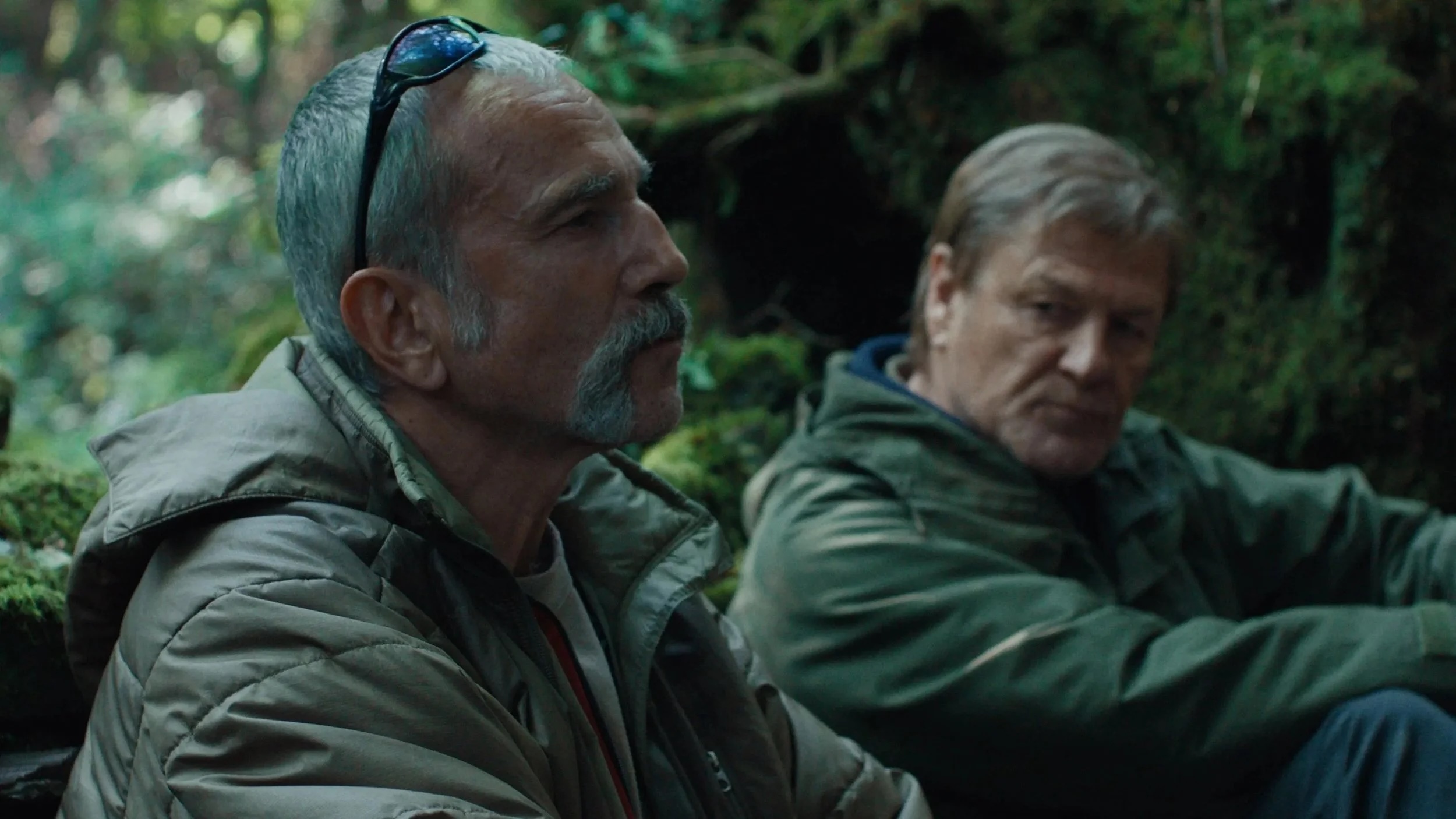
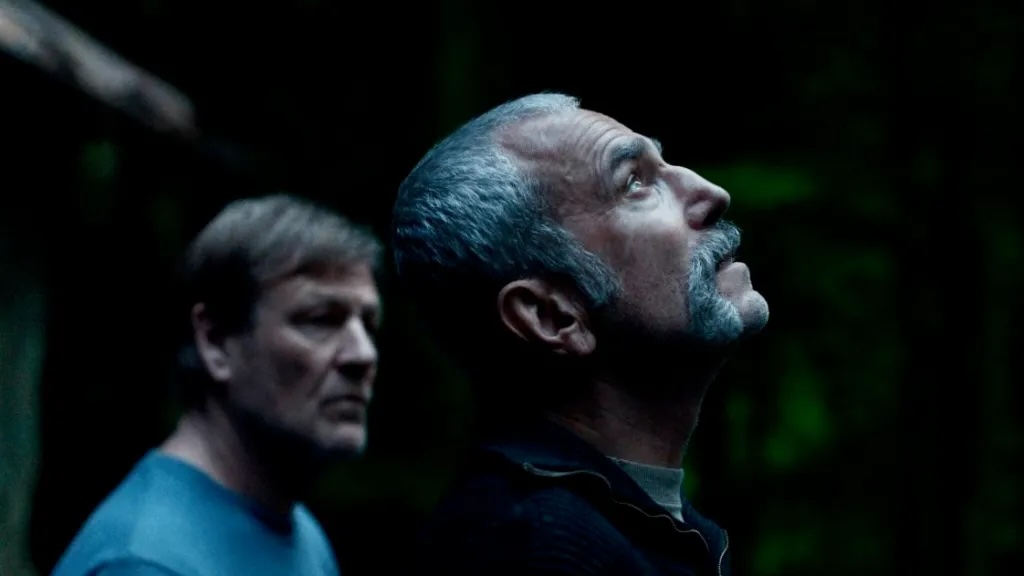
 Anemone is the kind of film that settles on your chest like damp winter air — heavy, cold, and unshakable. It’s a story built from grief and rot, about wounds that never heal and fathers who disappear long before they ever leave. Daniel Day-Lewis returns from retirement with a performance that feels carved out of bone: quiet, bitter, trembling beneath decades of guilt. His Ray Stoker is a former British soldier who defected from the IRA after one unthinkable mistake involving an innocent civilian. Since then, he’s been living like a ghost in a shack swallowed by the North England woods — a man trying to punish himself by simply continuing to exist.
Meanwhile, his brother Jem (Sean Bean) stepped into the life Ray abandoned — raising Ray’s wife (Samantha Morton) and child as his own and trying to stitch together the family his brother tore open. But the damage passed down anyway. Ray’s son Brian (Samuel Bottomley), now grown, has inherited the violence like a family heirloom, lashing out in the military, attacking a fellow soldier for uttering his father’s cursed name. What he doesn’t know — what no one had the heart to tell him — is that the man he’s defending isn’t his father at all.
The film opens with these two storylines living side by side, like parallel wounds that haven’t stopped bleeding. It’s unrelenting, yes — dense, sorrowful, often suffocating — but never empty. Director Ronan Day-Lewis (who shows an astonishing eye for mood and silence) builds a world that looks perpetually waterlogged, lit like a supernatural horror film even though the horrors here are painfully human. Ben Fordesman’s cinematography makes every landscape look bruised; every room looks like it’s waiting for a confession that no one wants to give.
And then there’s Bobby Krlic’s score — a slow, shaking thing that sounds like a heartbeat felt through a cracked rib. Acoustic instruments and synths collapse into each other like someone trying to stand up too quickly after a night spent on the cold tile floor. It fits Ray’s mental state perfectly: half-awake, half-drowned, never fully present.
Day-Lewis delivers one of his strangest, rawest monologues in years — a jagged, unsettling confession about surviving abuse at the hands of a priest who targeted him instead of Jem. It’s the kind of moment that stops the whole film, not because of the shock, but because of the exhaustion behind Ray’s eyes. This is a man who has been living with his trauma so long he’s forgotten how to speak without it.
Despite the misery, Anemone has a real emotional intelligence humming underneath. It’s about fathers who fail their sons, sons who carry the fallout, and cycles of pain that feel older than memory. Abuse becomes inheritance. Violence becomes lineage. Ray has tried to remove himself from the world to stop the cycle, but all he’s really done is force his family to live with the absence he left behind.
When Jem finally drags Ray out of his hovel — filthy, wild-haired, barely able to function — it isn’t for justice or forgiveness. It’s for Brian. It’s an attempt to stop the damage before the next generation disappears completely. Their reunion is bitter, broken, and darkly funny in the way only two men with decades of shared pain can manage.
“You’re going to hell,” Jem tells him.
“Family reunion,” Ray spits back.
By the final act, the film begins to unravel under the weight of its own ambition — threads loosen, structure collapses, and the narrative becomes more abstract than it needs to be. But even when it stumbles, the emotional force of what came before holds strong. You find yourself forgiving its missteps because the core — the bruised, pulsing humanity — never goes away.
—
Anemone may be a punishing watch, but its 4K UHD Blu-ray presentation is anything but. The Dolby Vision transfer pulls an impressive amount of nuance out of the film’s intentionally murky palette—grays, greens, and cold blues dominate, but they’re rendered with striking precision rather than the muddy flatness that can plague dark, low-saturation films. The movie relies heavily on overcast daylight, candlelit interiors, and dense woodland shadows, and the HDR grading handles all of it with remarkable stability. Blacks are deep without crushing, allowing you to see detail in Ray’s cluttered hovel, in the texture of tree bark during long walk-and-talk sequences, and even in the corners of the frame where lesser transfers would simply give up.
Fine detail is consistently strong. Every crease in Daniel Day-Lewis’s weather-beaten face, every bead of moisture clinging to his coat, every stitch in Sean Bean’s woolen layers comes through with tactile sharpness. The film’s frequent close-ups, often shot in unforgiving natural light, reveal skin textures, graying stubble, and unglamorous imperfections without any artificial smoothing. The damp environments—mossy stones, soggy leaves, rain-slicked mud—display a realism that makes you practically feel the cold.
Grain is present but well-managed. The encode preserves the film’s natural texture without introducing noise, and the darker sequences remain clean and stable. There’s no sign of banding in the foggy horizon shots or in the lamplit interiors, both of which often expose weaknesses in streaming presentations.
—
Anemone isn’t a crowd-pleaser. It isn’t warm. It isn’t easy. But it’s alive in a way so few modern dramas dare to be — uncompromising, mournful, and made with a confidence that suggests Ronan Day-Lewis is a filmmaker with real staying power.
The title comes from the flowers planted by Ray’s father long ago. Fragile things that somehow survive the cold. In a way, that’s what this film is too.
A story about what grows — and what refuses to die — even after everything has gone to ruin.
Are you a fan of this movie? Let me know what you think in the comments below.
Cheers,
Matt.
While your here, check out more of my 4K & Blu-ray reviews. Even more, see the newest trailers, press releases, music and more on the rest of the site. Follow me for faster updates on Twitter and Instagram